Tokyo private high schools: first-choice recommendation, 併願優遇, and the December consultation
東京の私立高校入試 推薦入試・併願優遇・入試相談
- Applies to
- All of Japan
- Source last checked
- , Open the Japanese source
- Official source
- 知っておきたい入試のこと(東京私立中学高等学校協会 高等学校版)
Tokyo's association of private junior and senior high schools (東京私立中学高等学校協会) explains the two ways most private high schools in Tokyo admit students: a recommendation exam (推薦入試, suisen nyūshi) and a general exam (一般入試, ippan nyūshi).
Recommendation: the school must be your first choice
All three conditions apply:
- The private school is the student's first choice. If the student passes, they must enrol. They also cannot sit a Tokyo public high school's recommendation or another private school's recommendation.
- The junior-high principal gives a recommendation letter (推薦書).
- The student meets that school's own recommendation standard (推薦基準). It differs by school, so get the guidebook (募集要項) at an information session.
Families often call this 単願 (tangan, single application); the association's page calls it the recommendation exam. In principle, the student applies after the entrance consultation described below.
Each school chooses from document screening, a composition, an interview, a practical test and an aptitude test (適性検査). The page says an aptitude test is often Japanese, math and English in a shorter time than the general exam.
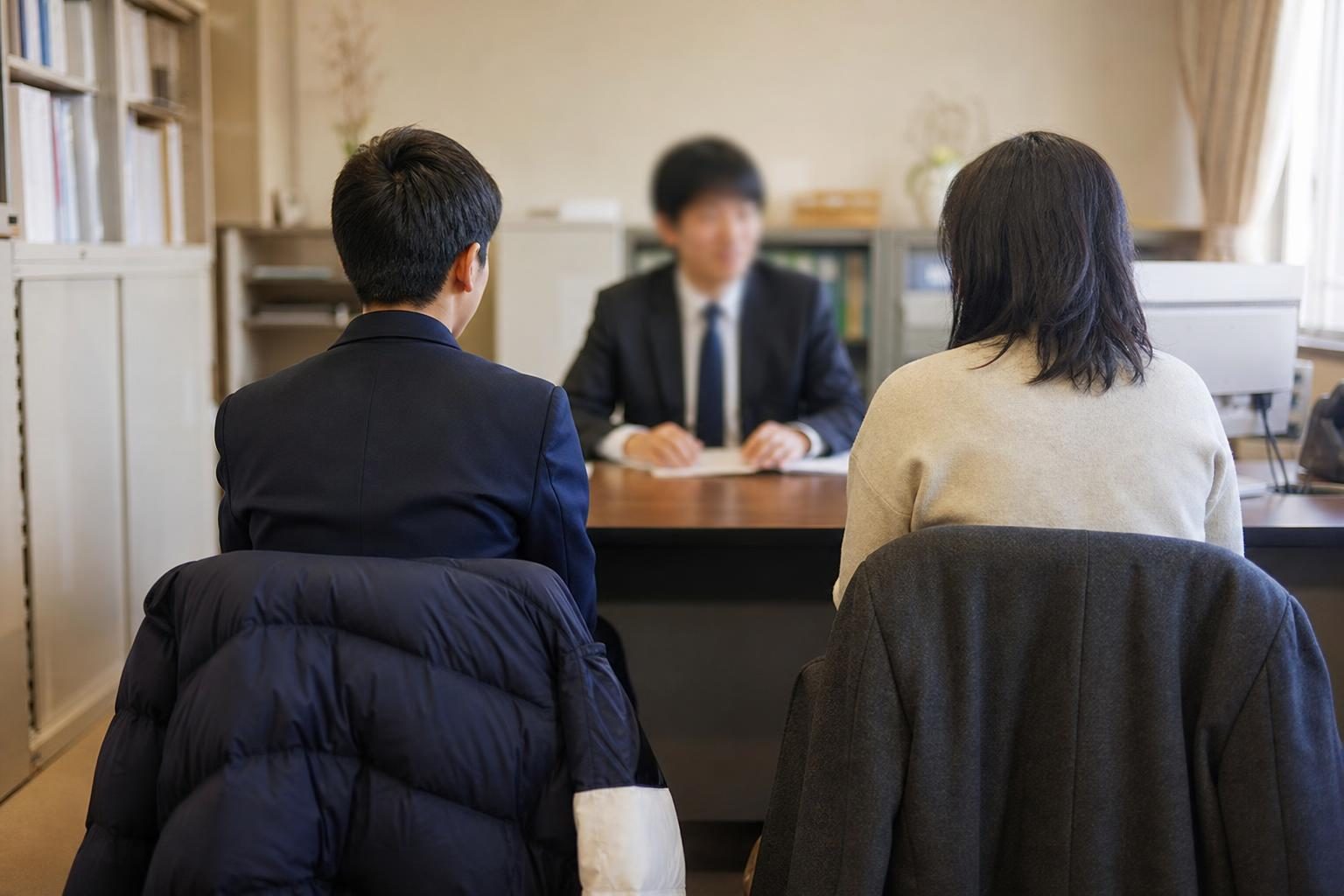
The entrance consultation (入試相談)
For a recommendation, and for a general exam with 併願優遇, the private school checks with the junior-high teacher whether the student meets its standard and what their school life has been like. The school then tells the teacher the possibility of passing. It is usually held over a few days from 15 December.
It uses the junior high's records: grades and viewpoint ratings (内申, 観点別評価), practical skills, activities and attendance. The page says it does not use deviation scores (偏差値) from commercial mock tests. It gives only a possibility. The association says it is never a promise or an informal offer (確約, 内定), and a student can still fail.
Students at public junior highs in Kanagawa follow the same steps as Tokyo. Saitama, Chiba and other prefectures follow their own associations' rules, and in some, such as Saitama, the junior-high teacher does not hold the consultation. Ask the private school.
General exam, with or without 併願優遇
Most schools use Japanese, math, English and an interview. Some use two subjects and an interview, or a composition; arts schools may add a practical test.
併願優遇 (heigan yūgū, preference for a back-up applicant) is for a student whose first choice is a public high school. The usual deal: if the student passes with this preference and then fails the public school, they enrol at the private school. The private school sets a standard, such as grades, and gives students who meet it an advantage, such as added points. How it works differs by school.
- It needs the entrance consultation, so decide target schools by the three-way meeting around December (三者面談) and talk to the homeroom teacher.
- No principal's letter is needed.
- Some schools do not offer it.
- It is only an advantage. Below the line on the test day, the student fails. The association says applying to more than one private school is needed for safety; the conditions for combining schools differ.
Taking the general exam without the preference is called a free exam (フリー受験).
Earliest dates each year
| Consultation | Apply from | Exam from | |
|---|---|---|---|
| Recommendation | 15 Dec | 15 Jan | 22 Jan |
| General (併願優遇) | 15 Dec | 25 Jan | 10 Feb |
| General (free exam) | — | 25 Jan | 10 Feb |
Each school sets its own day on or after these dates. Returnee exams (帰国生入試) may be held from 20 November; the association's own definition is a stay abroad of at least one year and a return within three years.
The association's chart puts the Tokyo public recommendation tests on 26–27 January and the public first-round exam on 21 February. A student who passes a public first-round exam or a private general exam can choose which school to attend. A student who passes a recommendation exam, private or public, cannot decline it.
Verify each school's conditions in its guidebook and at its information session.
Your child's dates, not the general ones
Add your child and ward. The timeline does the rest.