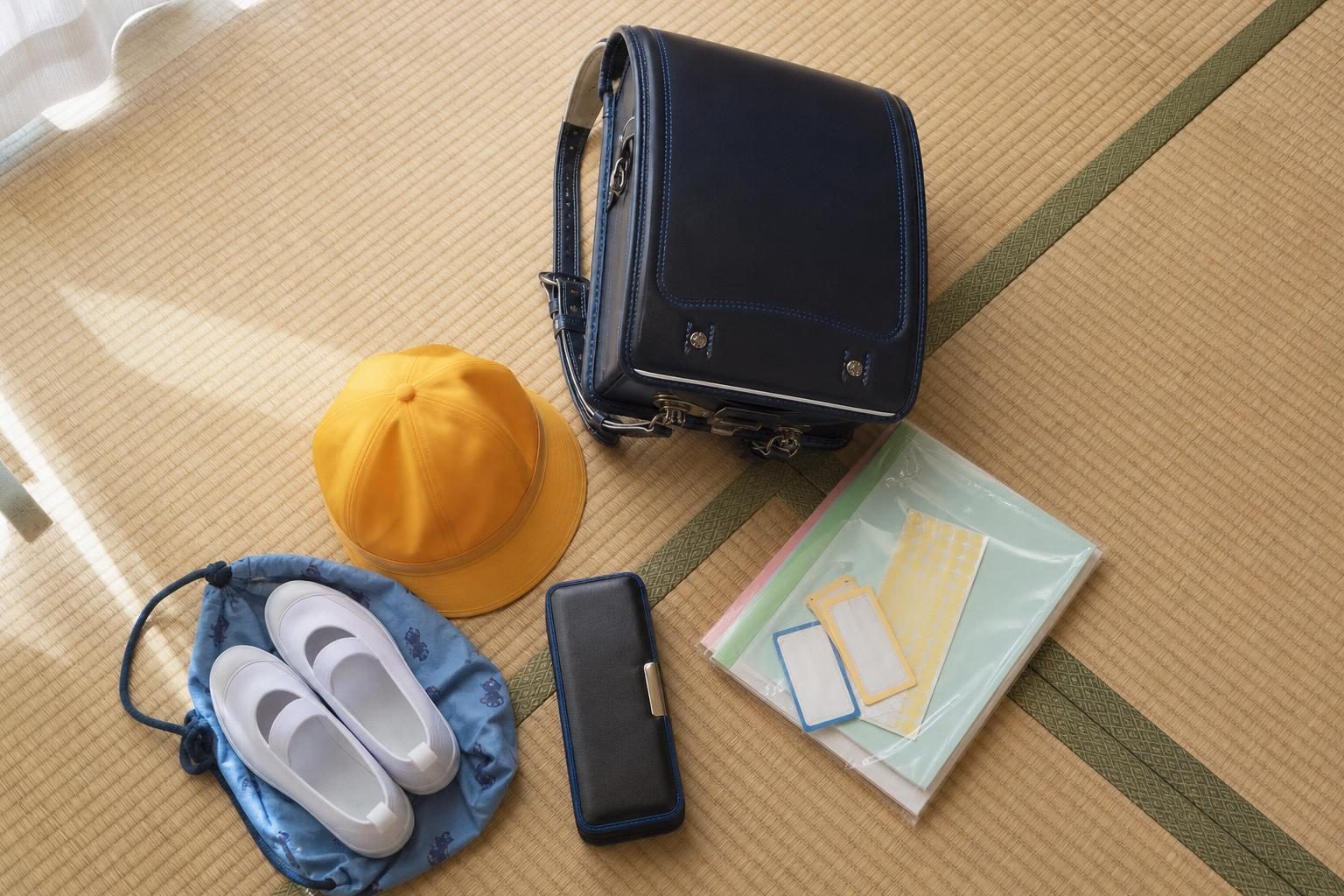
What one Tokyo ward school asked new first graders to prepare: randoseru, hat, indoor shoes
文京区立礫川小学校 入学のしおり(入学までに用意する物)
- Applies to
- Bunkyo only文京区
- Source last checked
- , Open the Japanese source
- Official source
- 令和8年度 新入学説明会資料 入学のしおり(文京区立礫川小学校)
Rules for Bunkyo only. Other wards differ: check with your ward office.
Your child's school gives you its own list at the briefing for new parents (新入学説明会, shin-nyūgaku setsumeikai). Until then, here is what one ward school, Rekisen Elementary in Bunkyo (文京区立礫川小学校), asked for in its handout for the April 2026 intake. Read it to see the kind of list to expect. It is not your school's list.
The school bag
The handout asks for a randoseru (ランドセル, the stiff backpack first graders carry), bought on the assumption it will be used for six years. It does not set the shape or the colour. Another page of the same handout says children come to school with a randoseru or something equivalent (準ずるものでも可).
Given by the state, the ward or the school
- Textbooks, free from the state, handed out on the entrance-ceremony day. Write the name on them in hiragana.
- A yellow badge (黄色いワッペン) from the ward, free, which carries traffic-accident insurance.
- A randoseru cover and a personal alarm (防犯ブザー, bōhan buzā), which the ward was due to supply.
Bought by the school in bulk and handed out on the day
Notebooks (Japanese, maths, a free notebook), a contact notebook and a bag for printouts (連絡帳・連絡袋), a tool box for the desk (道具箱) and a name tag.
Prepared at home, with grade and name written on before the ceremony
- The school's own hat and badge set (礫川帽子・バッジ). This one is specified by the school.
- A pencil case: simple, sturdy, box type.
- Pencils, 2B or B, four or five. One red and one blue pencil (a red-and-blue pencil is fine).
- An eraser (simple, unscented) and a pencil board (下敷き, shitajiki).
- For the tool box: scissors, coloured pencils, and crayons or pastels.
- PE kit and a bag for it: white short-sleeved shirt, navy shorts and a red-and-white cap, all year round.
- Indoor shoes (上履き, uwabaki) and a bag for them. They go home every Friday to be washed.
- A cover for the disaster helmet (防災ヘルメットカバー). Buy it or make it.
- An art bag and a music bag, at least 35 × 25 cm.
- One floor cloth (雑巾, zōkin), the size of a towel folded in four.
- A lunch mat (about 60 × 40 cm) and a small lunch bag (about 12 × 15 cm) for the mat, a small towel and a spare mask.
Everything, including clothes and underwear, is labelled in hiragana. Other supplies are announced in the grade newsletter after entry.
On the entrance-ceremony day
That handout asked families to hand in at reception: the school entry notice (就学通知書, shūgaku tsūchisho), a school-record card, a map of the route to school, a form about the child's image and copyright, and an automatic-payment form. Children brought indoor shoes and their bag, the randoseru, a handkerchief, tissues and the school hat. A tote bag was suggested because a lot goes home that day.
Things to practise before the first day
The handout lists: answering clearly when their name is called, tidying their own things, changing clothes alone, listening to the end and saying what they need, telling their own belongings apart, greeting, reading their own name in hiragana, and road-safety rules.
Your school's list will be its own. Items marked as school-specified apply only to this school.
Your child's dates, not the general ones
Add your child and ward. The timeline does the rest.