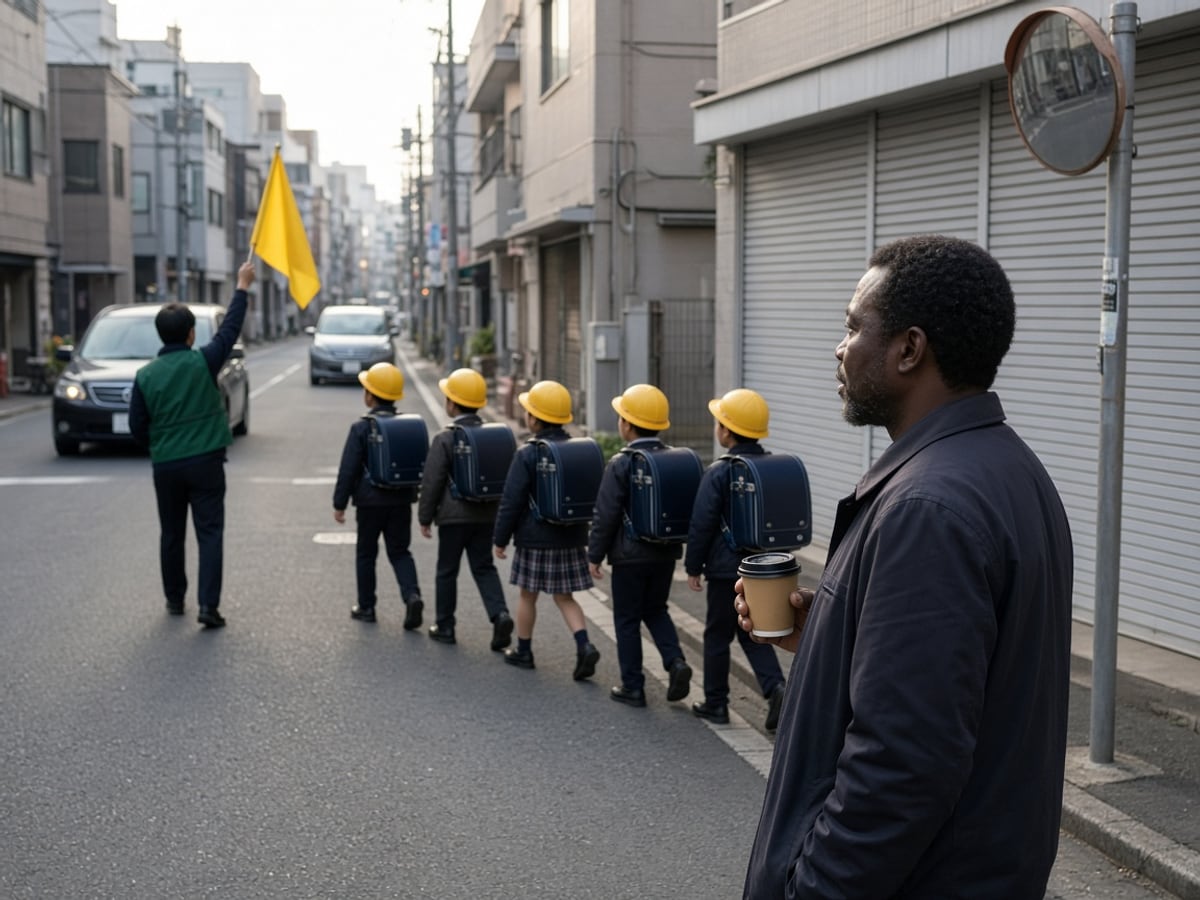
The walk to school, and the injury insurance Ota pays into
通学の安全と日本スポーツ振興センターの災害共済給付(大田区)
- Applies to
- All of Japan
- Source last checked
- , Open the Japanese source
- Official source
- 令和8年度 大田区教育委員会 教育概要(学校保健・安全、通学路、災害共済給付)
The walk between home and a Japanese elementary school is something the ward plans for, and an injury during the school day is something the ward insures. Ota's FY2026 education overview is the paper that states both for Ota's ward schools. Another ward writes its own rules. Where this page gives a number, the number is Ota's.
Lessons before the children walk alone
Ota has posted two traffic-safety instructors since FY1997. They teach three things: how to walk and how to cross at a crossing, how to check a bicycle and ride it correctly, and the traffic rules of ordinary days. The lessons mix practice and talk. They are for children at ward elementary and junior high schools.
In FY2025 the overview records:
| Lesson | Who | Times | Children |
|---|---|---|---|
| Walking practice | Elementary grade 1 | 58 | 4,468 |
| Bicycle class, including in the summer holiday | Elementary | 55 | 4,374 |
| Guidance as children leave school | Elementary | 46 | 3,405 |
| Traffic-safety class, including in summer | Elementary | 94 | 18,712 |
| Traffic-safety class | Junior high | 6 | 901 |
A new grade-1 child at a ward elementary school is given a personal alarm (防犯ブザー) at entrance, to carry on the randoseru on the way to and from school. The April issue was 4,487 alarms in FY2026, 4,911 in FY2025, and 5,010 in FY2024. A grade-1 child who lives in Ota and attends an elementary school that is not a ward school can receive one by applying. The overview does not print a price; the school hands the alarm out.
On the commute route of every ward elementary school, the ward installs five security cameras in principle, to back up the watching that schools, guardians, the PTA and neighbours already do. Separately, cameras stand by the gates: four cameras, two monitors and one recorder at each ward elementary school (five cameras and three monitors at Tateyama Sazanami School), installed in FY2021, and the same four-camera set at every ward junior high by the end of FY2018. Five cameras on a route are the complement the overview describes. They are not a camera on every corner.
If a child is hurt under school management
Ota pays medical costs and related benefits for injury under school management (学校管理下) at its ward elementary and junior high schools, through a contract with the Japan Sport Council (独立行政法人日本スポーツ振興センター). The legal basis the overview names is the Japan Sport Council Act. The method it describes is that the ward pays the enrolment contribution (加入金) and the scheme pays benefits for a disaster under school management (日本スポーツ振興センターの災害共済給付契約の加入金を納付し、学校管理下での災害に対し医療費等の給付を行う).
In FY2025 that was 2,333 benefit payments, totalling ¥23,374,145. FY2024 was 2,477 payments and ¥24,512,793. FY2023 was 2,533 payments and ¥21,974,340. Those are ward-wide totals, not the size of one family's payment.
The overview does not list the walk to school as its own line, and it does not print the share of a clinic bill that a family still pays. Ask the school, when a specific injury happens, whether that injury is inside 学校管理下. The school is the body that sits on the contract.
Cases the Japan Sport Council benefit does not cover can still be helped. Ota pays its own disaster-treatment cost (大田区災害診療費) for school-management injuries outside that benefit, to reduce what guardians pay. The overview does not print the yen rules for that ward payment.
A different pot of money is for illness, not for a fall on the stairs. Guardians already receiving public assistance, or the near-assistance category, whose child is told by the school to treat an illness on the list in the School Health and Safety Act, can show a medical ticket at the clinic so the insured patient's share is covered. In FY2025 that aid reached one child, ¥24,810. It is not the injury scheme.
Closure news on the same mail
Ota's school emergency mail goes to guardians of ward elementary and junior-high pupils who register, and to staff. The messages are: an incident or a danger concerning a child; whether a school event will happen or is cancelled; news of a school closure because of a typhoon or similar (台風等による休校の情報); and anything else the principal decides to send. Registering also turns on the ward's crime-prevention mail. The overview does not state which weather warning closes the school, or at what time in the morning the decision is made. The mail is how the closure, once decided, is sent.
What to do now
- In grade 1 at an Ota ward elementary school, expect the alarm at entrance and put it on the randoseru. If your child attends another elementary school and you live in Ota, ask to apply for the grade-1 alarm.
- Ask the school when the grade-1 walking practice and the bicycle class are. The FY2025 counts show they are ordinary lessons, not a one-off.
- If your child is hurt at school, tell the school the same day and ask whether a Japan Sport Council claim applies. The overview does not give a parent a form name; the school handles the contract.
- Ask, in the same conversation, whether the injury falls instead under Ota's own disaster-treatment payment.
- Register for the school emergency mail so a typhoon closure reaches you. Ask the school for the rule that decides the closure: it is not printed in this overview.
Your child's dates, not the general ones
Add your child and ward. The timeline does the rest.