JASSO grants before university: which residence status can apply, and what is paid
給付奨学金の予約採用と、外国籍の申込資格
- Applies to
- All of Japan
- Source last checked
- , Open the Japanese source
- Official source
- 進学前(予約採用)の給付奨学金の申込資格(日本学生支援機構)
The grant scholarship (給付奨学金, kyūfu shōgakukin) from the Japan Student Services Organization, JASSO, does not have to be paid back. The pre-enrollment route is called reserved adoption (予約採用, yoyaku saiyō). You apply through the high school before you start university, a junior college, or a specialized-training college. The page does not say that every applicant is selected. Household income and school record are separate pages on the same site.
This is not the high-school tuition support that reduces a high-school bill. It is money, and a linked tuition reduction, for after high school.
Who can file before they enrol
The page says either of these:
- Someone who will finish a high school, for the first time, in March 2027.
- Someone whose first high-school graduation was no more than two years before the day they apply.
An autumn graduation in 2026 is included. Someone who already received this grant at a university cannot apply again. Someone already enrolled uses the in-school route, not this one.
A student who is still in high school, or in the upper course of a specialized-training college, and who is expected to graduate, cannot file the equivalency-exam route directly with JASSO even if they have also passed that exam. They apply through the school. The equivalency exam (高卒認定) has its own extra timing rules on the same page, and those applicants file with JASSO directly only when they are not currently enrolled.
Tuition reduction under the new higher-education support system, including the reduction for households with three or more children, is requested inside this same grant application. The form asks whether you want that system.
The residence-status rule
A student who is not a Japanese national has to fit the rules above and one of the following. The page asks for proof: a copy of the residence record or of the residence card.
(1)法定特別永住者
(2)在留資格が、「永住者」、「日本人の配偶者等」または「永住者の配偶者等」である人
(3)在留資格が「定住者」であって、将来永住する意思がある人
(4)在留資格が「家族滞在」であって、次の条件をすべて満たす人
The four conditions for Dependent (家族滞在), all of them, are:
- You entered Japan by the end of the school year in which you turned 12, or you finished elementary school in Japan.
- You finished junior high in Japan. The page includes night junior high, the upper years of a compulsory-education school, the lower course of a secondary school, and the junior-high department of a special-needs school.
- You have finished, or will finish, a Japanese high school or the equivalent the page lists (part-time and correspondence included, the upper course of a secondary school, the high-school department of a special-needs school, the third year of a college of technology, an upper course at a specialized-training college of at least three years, or the equivalency exam).
- After university you intend to work in Japan and settle here.
If the residence period on the card has already expired on the day you apply, and the status is spouse of a Japanese national, spouse of a permanent resident, long-term resident, or Dependent, you also file proof that a renewal is pending. Dependent status also needs proof of the date you entered Japan. The page points to the application handbook for how to send it.
JASSO's FAQ on My Number states the same list and then says:
在留資格が上記以外(「留学」等)の方には、申込資格がありません。
Student (留学) is the example the FAQ gives of a status that cannot apply. The pages do not offer a substitute status. A foreign national who has a My Number because they are a mid- to long-term resident, including a long-term resident, or a special permanent resident, and who has a residence record, still has to submit the My Number. That FAQ is about the number, not a second way to qualify.
What is paid
The amount page says that once you are adopted, the monthly sum for your income band, the type of school, and whether you live with the parents, is in principle paid every month until the normal graduation date.
For a university, junior college or specialized-training college, private, living with the parents, the page lists 38,300 yen a month in band 1, 25,600 in band 2, 12,800 in band 3, and 9,600 in band 4. The page limits band 4 to 多子世帯 (tashi setai, households it marks as having multiple children) and does not, on that page, define the number of children. Living away from the parents, the same page lists 75,800, 50,600, 25,300 and 19,000 yen. A national or public university, living at home, is 29,200, 19,500, 9,800 and 7,300 yen; living away, 66,700, 44,500, 22,300 and 16,700 yen. The figure in parentheses on the at-home line is for a student who lives with a parent receiving livelihood protection, or who needs social care and commutes from a children's home or a similar placement. The page's parentheses for private band 1 at home is 42,500 yen.
Living away means you have left the parents' household and you pay rent. A parent on a temporary single posting still counts as living at home. The amount page does not label the table as April 2027 only. Follow the school's packet if the handbook differs. An interest-free loan taken with the grant is reduced; an interest-bearing loan is not.
What to do, and by when
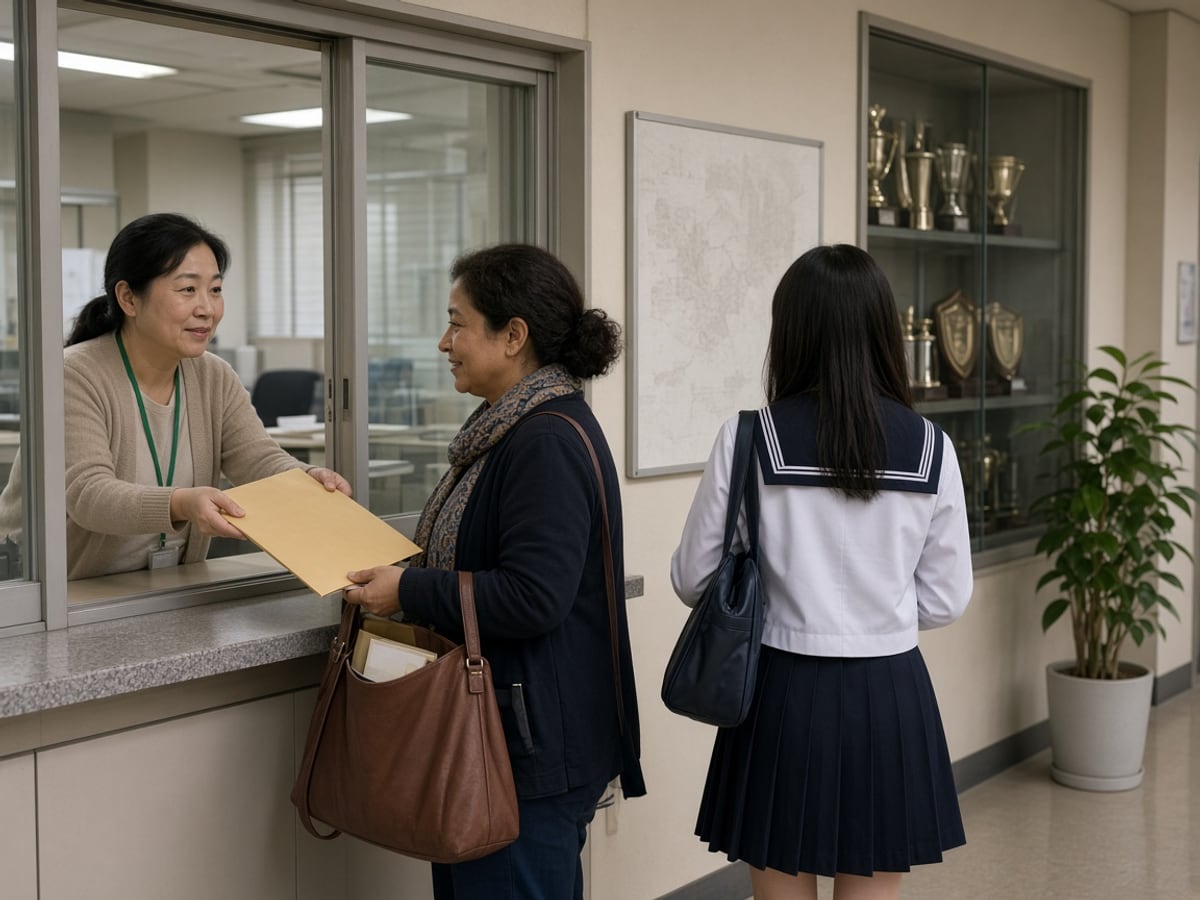
Reserved adoption is filed through the school you attend, or the school you finished if that was within two years. The school's deadline is the one that binds. The organization's handbook and the online system (スカラネット) are linked from the application page. You and the parent who supports the household provide My Number. A parent living overseas, with no My Number, follows the separate instruction linked from the FAQ. After you are selected you still file an enrollment notice (進学届) at the university. The university tells you how.
What goes wrong
What to do now
Your child's dates, not the general ones
Add your child and ward. The timeline does the rest.