Junior high in Tokyo: regular tests, the report card, clubs, and the three-way meeting
中学校の定期考査・評定・部活動・三者面談
- Applies to
- Tokyo
- Source last checked
- , Open the Japanese source
- Official source
- 学習評価の在り方ハンドブック(小・中学校編)(国立教育政策研究所、令和元年6月)
The number a Tokyo public high school later reads is not a single Friday test. It is the junior high's 評定 (hyōtei, the subject grade on a scale of 5 to 1). Families call the set of those grades 内申 (naishin). The grade is the school's summary of the year's work. A regular exam is one piece of evidence the teachers use. It is not the grade by itself.
What the school is asked to record
The National Institute for Educational Policy Research, in the handbook it published with the Ministry of Education in June 2019, says each subject is looked at in three viewpoints, the 「知識・技能」、「思考・判断・表現」、「主体的に学習に取り組む態度」の3観点:
- 知識・技能 (chishiki ginō, knowledge and skill)
- 思考・判断・表現 (shikō handan hyōgen, thinking, judgement, and expression)
- 主体的に学習に取り組む態度 (shutai-teki ni gakushū ni torikumu taido, how the student takes on the learning)
Each viewpoint is recorded as A, B, or C. A means the learning is fully satisfactory against the goals in the national course of study. The handbook says teachers record this at the end of a unit of work, not by scoring all three viewpoints in every lesson.
The 評定 then sums those viewpoint records up. At junior high it is a five-step grade. (At elementary school the handbook uses three steps, and the youngest grades do not get a 評定 at all.) The report card, 通知表 (tsūchihyō), and meetings with parents are how the school is expected to share this. The handbook also says the 評定 is what a senior school can use on the report it receives, the 調査書 (chōsasho).
What a regular exam is doing
Schools call those exams 定期考査 (teiki kōsa) or 定期テスト. Nerima municipal Yasaka Junior High, in its notice of 1 November 2024, told parents the three-way meeting would use everyday study and the results of the regular exams to agree how the student should study next. That school's year plan for Reiwa 6 listed regular exams, including a nine-subject sitting and a five-subject sitting. The dates on that plan are for that school year. The current year's dates are on the new plan the school sends home.
A strong paper does not set the 評定 on its own, and one weak paper does not either. The three viewpoints also include work the exam does not show: labs, speaking, notebooks, and whether the student keeps going when the work is hard. Ask the teacher, at the meeting, which of those the grade is using this term.
The three-way meeting
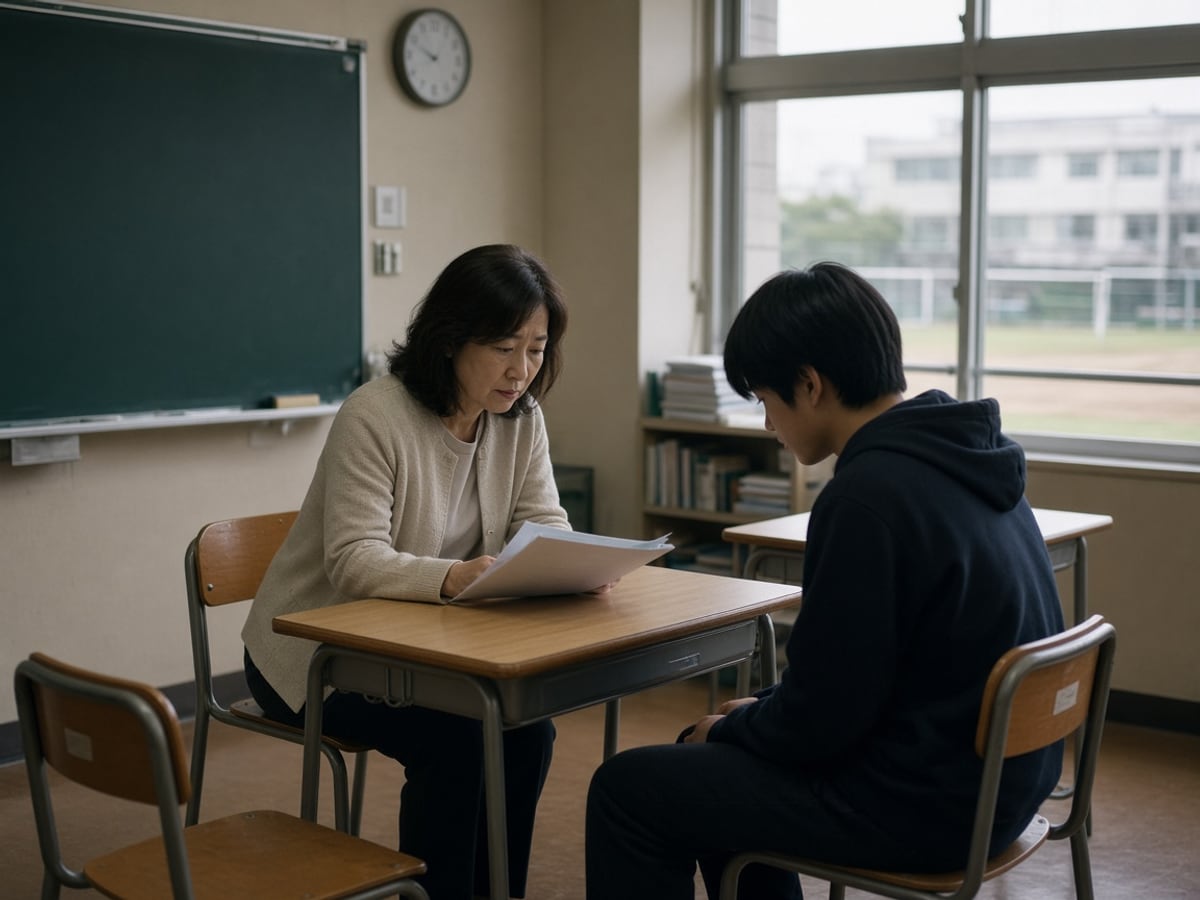
三者面談 (sansha mendan) is a meeting of the homeroom teacher, the student, and a parent. Yasaka's November 2024 notice set three jobs for it:
- Look at everyday study and the regular exams, and agree what to change.
- Look at life at school and at home, and name what should improve.
- Talk about the next school. The notice says this is mainly for third years.
That sitting ran from Monday 2 December to Monday 9 December 2024. First and second years were scheduled from 13:40 to 16:00, third years from 14:10 to 16:30, about 20 minutes each, in the classroom. The homeroom teacher sent the actual slot after families replied. The reply was due at 17:00 on Friday 8 November 2024, on the school's app, by marking times that did not work. Another school will use another week and another app. Use the date on your notice.
During that week the school told families to stay home and study until 15:30 (15:00 on Wednesday). Clubs started at 16:00 or later. Check the club adviser for the exact time.
Clubs and the school handbook
部活動 (bukatsu) is the after-school club. Suginami municipal Amanuma Junior High publishes its club rules beside a school-life handbook (学校生活の手引き, gakkō seikatsu no tebiki). Read the copy your own school hands out. During Yasaka's meeting week, clubs started at 16:00 or later. If club time and study are colliding in third year, say so in the meeting. The notice asks you to talk at home first, so the 20 minutes are used on the real question.
What to do, and by when
Tokyo's Board of Education, in the April 2027 public high-school guidelines, takes the third-year grades as they stand on 31 December 2026. The first and second terms of third year are what the junior high is told to reflect (at a two-term school, the first term and the second term up to that date). Ask the homeroom teacher which term's 評定 will be on the 調査書. Do that at the autumn meeting, not in February.
| When | What to do |
|---|---|
| Each time a 通知表 comes home | Read the 5-to-1 grade and the A-B-C viewpoints. Ask what would move a subject. |
| The week the meeting notice arrives | Reply by the printed deadline. Write your questions down first. |
| Third-year autumn | Use the meeting to name the next school and the exam route the family is considering. |
| Before 31 December of third year | Treat the grades on record then as the ones the public high school will see. |
The meeting notice does not ask for a fee. Regular exams at these public junior highs are part of the school day, not a paid sitting.
What goes wrong
A juku practice score and the 内申 are different records. The grade the high school reads is the junior high's 評定.
Yasaka wanted the slot survey back by a Friday at 17:00, weeks before the meeting. A late reply means the school picks the time. Yasaka and Amanuma are two public schools. Your own letter sets the week, the weight of the exam, and the club rules.
The handbook's A-B-C and the five-step 評定 do not promise a place at any high school. They describe the record. How a particular metropolitan high school turns that record into points is in that school's row of the board's guidelines.
What to do now
- Find the latest 通知表 and circle any subject at 1 or 2, and any viewpoint that is not A or B.
- Put the next 三者面談 date, and the reply deadline, on the same calendar as club practice.
- If the meeting will be in Japanese and that is hard, tell the homeroom teacher when you send the slot reply, and ask who may come with you. Yasaka's notice says the meeting is, in principle, the teacher, the student, and a parent.
- In third year, ask which term's grades will be sealed into the 調査書 for April 2027.
- Read your school's own 学校生活の手引き before you argue with a rule you have only heard about.
Your child's dates, not the general ones
Add your child and ward. The timeline does the rest.