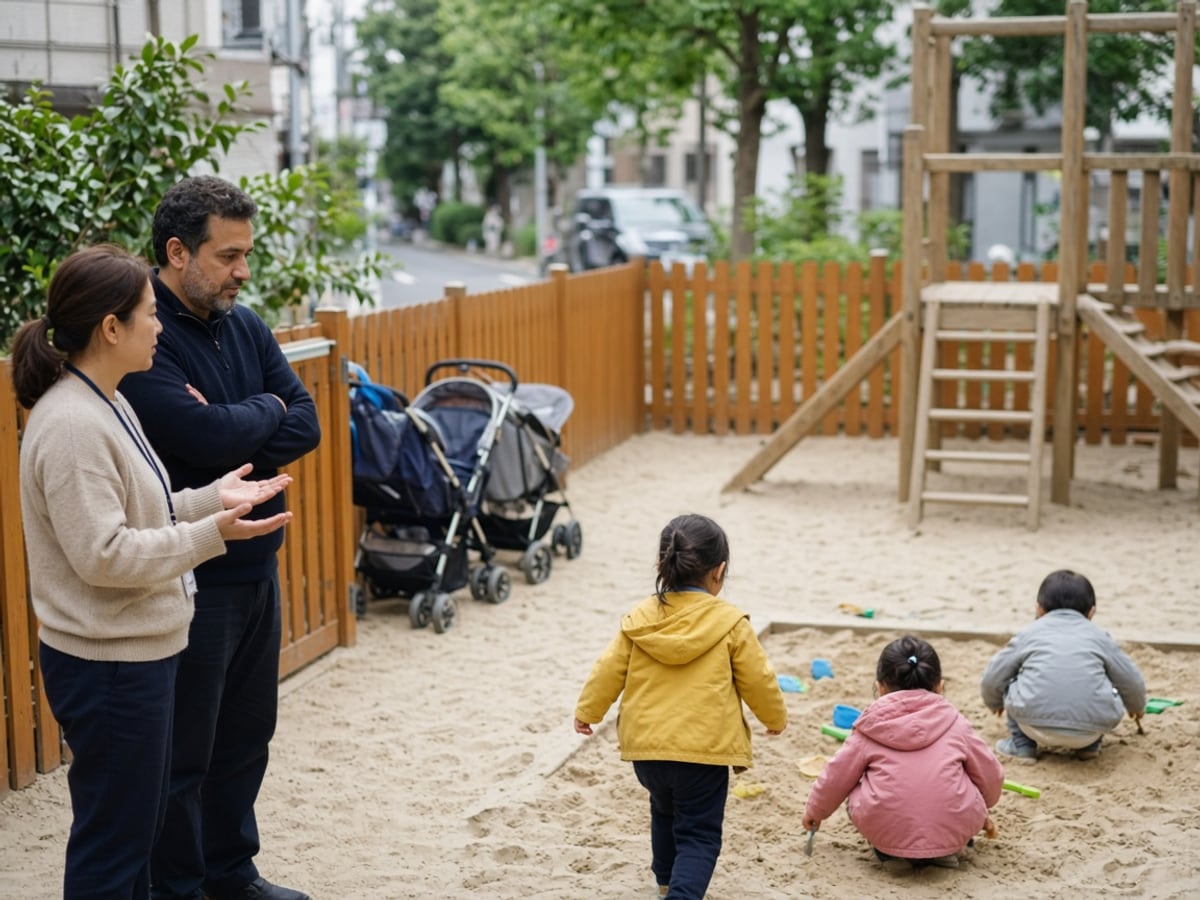
An international preschool: what the free-fee rules will and will not pay
インターナショナルスクールと幼児教育・保育の無償化
- Applies to
- All of Japan
- Source last checked
- , Open the Japanese source
- Official source
- 幼児教育・保育の無償化に関する自治体向けFAQ【2024年7月1日版】(こども家庭庁)
An international preschool is a name on a gate, not a status in the law. The Children and Families Agency's FAQ says there is no legal definition, and whether the free preschool system (幼児教育・保育の無償化, mushoka) pays anything depends on how that particular school is set up and on whether your household has a childcare-need certificate.
インターナショナルスクールについては、法令上の定義はなく、その設置形態等は施設によって様々であり、今般の幼児教育・保育の無償化の対象となるかは、それぞれの施設の設置形態や保育の必要性等によって異なってきます。
Nationality is not the test. The same FAQ says the child-and-childcare system, and this free-fee system with it, follows where the child actually lives. A foreign passport, a missing family register, and an address inside a U.S. base are all still inside the rule when the child lives in the municipality.
Three setups, three answers
Ask the school which of these it is.
| How the school is set up | What the free-fee system does |
|---|---|
| Licensed as a kindergarten (幼稚園の認可) | The kindergarten rules apply. On the new system, the category-1 user charge is free. Off that system, the fee is free up to ¥25,700 a month (the FAQ's 月額2.57万円). |
| Not a kindergarten, but it has filed as an unlicensed daycare (認可外保育施設) and it is actually caring for young children | A child who needs childcare, and who is not already in a licensed daycare or a certified children's centre, can receive the facility-use benefit (施設等利用給付) up to the cap below. |
| A miscellaneous school (各種学校, kakushu gakko) | Outside this free-fee system. The FAQ's reasons: a miscellaneous school is not held to the early-childhood standards, and a school under the School Education Act is not an unlicensed daycare under the Child Welfare Act. |
今般の無償化の対象とはなりません。
An English-language preschool that chose miscellaneous-school status does not become eligible by calling itself a preschool.
A group programme that is none of the three — a class a community runs, with no kindergarten licence and no unlicensed-daycare filing — is also outside the facility-use benefit. The FAQ says a city may choose to help such a programme with its own money. That help is local, and this FAQ does not list which cities do it.
The cap, if the unlicensed route is open
The unlicensed cap is the national average licensed-daycare fee, and it is a ceiling on what you paid, not a grant of that size.
| Child | Monthly ceiling | Who qualifies |
|---|---|---|
| Age 3–5 | ¥37,000 | Childcare need certified, and the child is not in a licensed daycare, certified children's centre, or small local programme |
| Age 0–2 | ¥42,000 | The same, and the household pays no resident tax |
A place in another city still counts. You claim it from the city where you live. Occasional days and a monthly contract are both inside the ceiling. The city can pay you back, or it can pay the school directly if it has set that up.
Two stacks that feel similar and work differently:
- Kindergarten plus extra hours at a babysitter. The kindergarten and its own extended care come first (extended care up to ¥11,300 a month, or ¥16,300 for a non-taxable household in the months after the third birthday until 31 March). The babysitter is paid from whatever is left of that extended-care ceiling, and only when the kindergarten's extended care is short: under 8 hours on a weekday including the education hours, or open fewer than 200 days a year. If the kindergarten offers no extended care, the whole of that ceiling can go to the babysitter.
- Already in a licensed daycare. The daycare fee is free under the daycare rules. A second, unlicensed preschool on top is not paid by this benefit. You cannot hold the facility benefit and the facility-use benefit together.
Meals stay on the bill. For ages 3–5 the FAQ says the facility collects staple food and the side dish, as a licensed daycare does.
Employer-run daycare (企業主導型) is a third route: it is not this facility-use benefit. The FAQ says the employer's contribution fund makes a standard fee free for ages 3–5 and for non-taxable households at ages 0–2, and the family still pays for meals. The yen amount of that standard fee in the FAQ is labelled as a planned figure inside a July 2024 document. Use the figure the school and the fund give you now.
What you are paying for
This FAQ does not publish a tuition for an international preschool. The number on the school's fee sheet is the price. The public rules only cap what the city will refund or pay across, and only after the school has a status the FAQ recognises.
A household with one parent at home, or with working hours under the city's line, often has no childcare-need certificate. The FAQ says that certificate uses the same working-hours rule as licensed daycare: each city sets the line somewhere from 48 to 64 hours a month. Without the certificate, the unlicensed cap does not open. The kindergarten route, if the school actually is a kindergarten, does not need that certificate for the education fee itself. It does need it for extended care.
The free period for a kindergarten fee starts on the third birthday. For daycare, and for extended care in a taxable household, it starts the following April.
What goes wrong
- Treating the English name as a licence. The licence, the unlicensed-daycare filing, or miscellaneous-school status is the question that changes the bill.
- Counting on ¥37,000 while the child already has a licensed daycare place.
- Assuming a miscellaneous school will be accepted as unlicensed daycare. The FAQ says it will not.
- Forgetting meals, materials, and the part of the fee above the cap.
- Applying to the school's city. The claim goes to the city where the child lives.
What to do now
- Email the school and ask for three words in writing: kindergarten licence, unlicensed-daycare filing, or miscellaneous school. Keep the reply with the fee sheet.
- If it is an unlicensed daycare, ask your ward whether your working hours meet its childcare-need line, and file the facility-use certificate (施設等利用給付認定) before you rely on the cap in a budget.
Your child's dates, not the general ones
Add your child and ward. The timeline does the rest.