Bunkyo ward: the 6 a.m. weather rule that closes a school, and the day that does not count as absence
文京区立学校の気象警報発表時の対応(午前6時判断・臨時休業)
- Applies to
- Bunkyo only文京区
- Source last checked
- , Open the Japanese source
- Official source
- 台風接近・通過等に伴う気象警報発表時の対応について(区立小学校・中学校、区立幼稚園・幼稚園型認定こども園)(文京区教育委員会、2026年6月22日更新)
Rules for Bunkyo only. Other wards differ: check with your ward office.
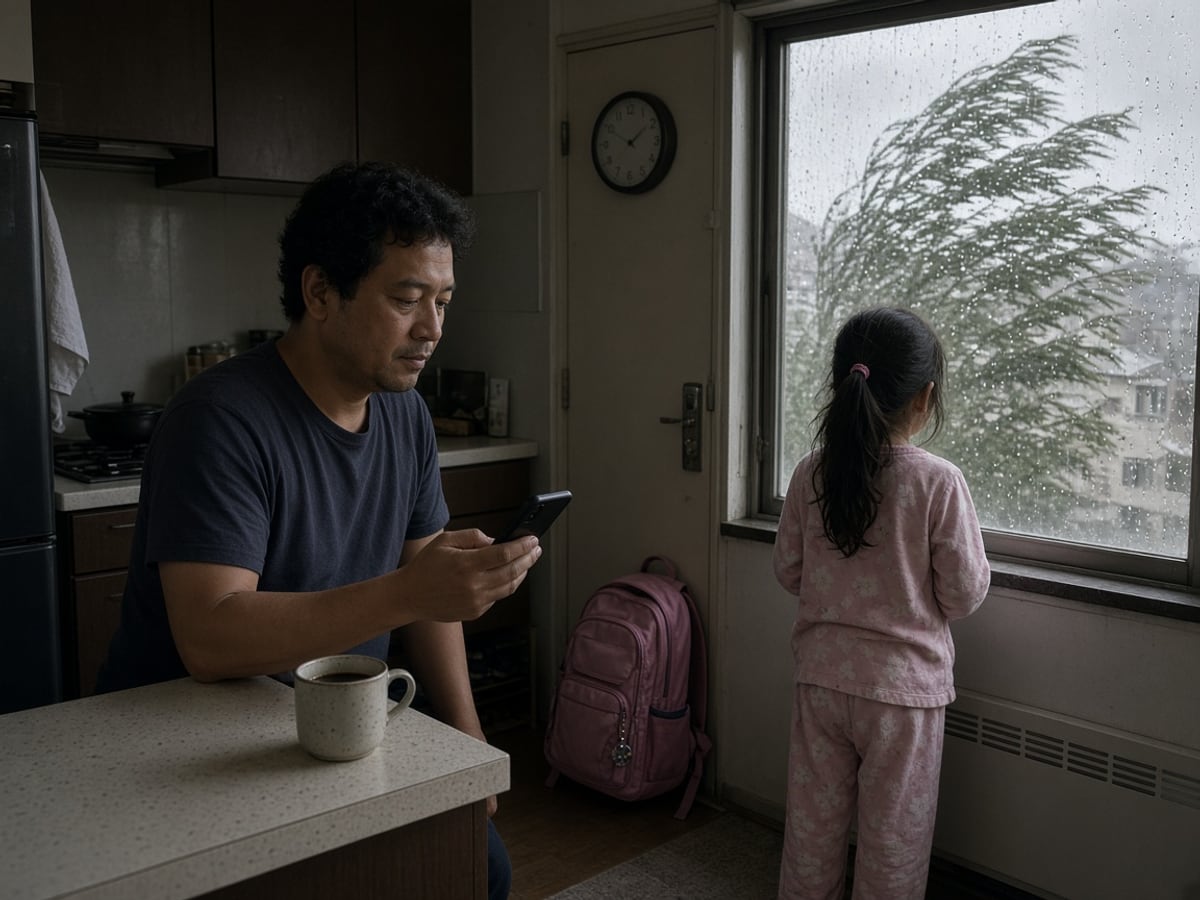
When a typhoon is coming, a Japanese public school does not decide in the morning whether to open. The ward's board of education publishes a rule in advance, and the school applies it. Bunkyo's rule (文京区立学校の 気象警報発表時の対応) was rewritten on 22 June 2026 for the new warning names Japan's weather agency introduced on 29 May 2026. It is the rule for every ward elementary and junior high school and ward kindergarten in Bunkyo. Other wards publish their own; the hour and the list differ.
The decision is made at 6 a.m.
午前6時の時点で、以下の防災気象情報が発表されている場合
At 6:00 the board looks at which warnings are in force for Bunkyo. If any of the closing warnings is in force, every school and kindergarten is closed for the whole day (臨時休業, rinji kyūgyō), and it stays closed even if the warning is lifted at 7:00. Kindergarten extended care is cancelled with it.
| Warning in force at 6:00 | What happens |
|---|---|
| Any level-5 special warning (特別警報: heavy rain, landslide, river flood), a storm special warning or a storm warning (暴風警報), or a level-4 heavy-rain danger warning | All Bunkyo schools and kindergartens closed |
| Level-4 Kanda River flood danger warning | Only 柳町小学校, 柳町幼稚園 and 後楽幼稚園 closed (they sit in the mapped flood zone) |
| Level-4 landslide danger warning | Only 根津小学校 and 根津幼稚園 closed (landslide-risk area) |
| Level-3 Kanda River flood warning or level-3 landslide warning together with a ward evacuation notice for the elderly (高齢者等避難) | The same specific schools, per the page's table |
| Level-3 heavy-rain warning, level-2 advisories | School is open as normal |
A railway suspension closes the school too
計画運休
If Tokyo Metro, the Toei subway, the JR Chuo–Sobu line or the Yamanote line announces a planned suspension, or says one is being planned, all schools close or delay the start of the day, whatever the warning level. Teachers commute by those lines; the page says so plainly.
How you are told, and what you decide
The school sends the decision through its app, C4th Home & School (H&S). If you are not registered, nothing reaches you; the registration steps are in reporting an absence and reaching the school. The page also points families to the weather agency's site and the ward's disaster portal for the typhoon itself.
On an open day you still decide. If you judge the route unsafe, keep the child home and tell the school through H&S. That day is not an absence:
出席を必要としない日
It is recorded as a day on which attendance was not required, so it never appears in the absence count that a junior high or an exam school later reads. See the report card for where that count lives.
When the weather turns during the day
If a storm warning, a level-4 danger warning or an evacuation order is issued after lessons start, children stay inside the school until the school confirms it is safe. If dismissal is brought forward, the school tells you through H&S; children may be walked home in groups once the route is checked, and you may collect your child instead. After-school care at the kindergarten is cancelled on an early dismissal, so someone must be able to collect the child. The separate rule for a large earthquake, where only a registered adult may collect the child, is in the emergency pickup drill.
What this means for a foreign family
- Nobody will phone you. The app is the channel, and the decision exists by 6:00. Look at the app before you leave for work, not at the sky.
- The closure is all-or-nothing by warning type, not by how the street looks. A grey, windy morning with no warning in force is a school day.
- "Not required to attend" is a real category. Using it is not truancy and needs no doctor's note; it does need the message to the school.
- A ward boundary matters. A child at a Bunkyo school whose family lives in Toshima follows Bunkyo's rule for the school and Toshima's for the after-school club, if the club is Toshima's.
What to do now
- Register every caregiver on H&S and turn its notifications on.
- Decide now who collects the child on an early-dismissal day, and give the school that person's name on the emergency contact sheet.
- Save the ward's disaster portal and the weather agency's warning page for Bunkyo on your phone.
- If you move wards, read the new ward's page: the hour and the list are different.
The page is Bunkyo's. Verify the rule for any other ward on that ward's own page.
Your child's dates, not the general ones
Add your child and ward. The timeline does the rest.