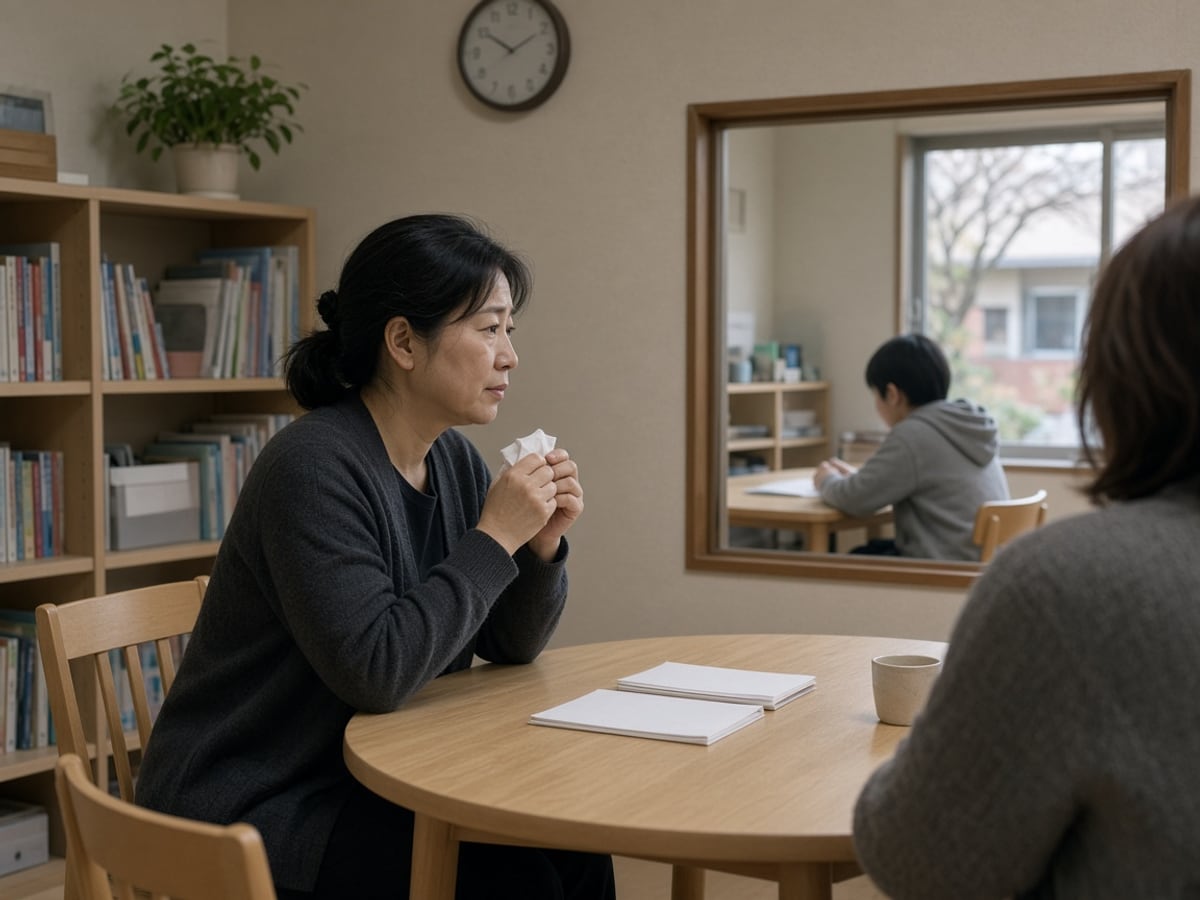
When a child stops going to school: the places, the attendance rule, and who decides
不登校の相談先と出席扱い
- Applies to
- All of Japan
- Source last checked
- , Open the Japanese source
- Official source
- 【保護者等向け】不登校児童生徒の出席扱い・成績評価について(文部科学省、2026年4月)
A child who is not going to school is in a situation Japan calls 不登校 (futōkō). The Ministry of Education's pamphlet on the Act on Securing Educational Opportunities says this is something that can happen to any child, and that the absence itself is not to be taken as problem behaviour (不登校は問題行動ではありません). The same pamphlet asks schools to help children look at their own path. The line it prints is
学校に登校するという結果のみを目標とせずに、子供たちが自分の進路を主体的に考えられるようにすることを後押しします。
Rest can be what a child needs. The ministry's 2019 notice, restated in 2023, also says to keep in mind the cost of missed learning, a narrower set of next schools, and the risk to standing on one's own later.
The school's job, in that notice, is to learn why this child stopped, to share that with the family and, where needed, with other agencies, and to make a plan for that child. A child who cannot settle in the ordinary classroom is someone the school is asked to find a way to receive.
Where to go first
The pamphlet's order is: talk to the school, and to the board of education's person for futoko consultations (不登校相談担当). They introduce learning places and counselling. The parent leaflet points to the ministry's list of local desks:
https://www.mext.go.jp/a_menu/shotou/seitoshidou/06112214.html
Inside the school, a room called the in-school education support centre (校内教育支援センター) is a quiet place for a child who can reach the building and cannot yet enter the class. A school counsellor (スクールカウンセラー, often a certified psychologist) and a school social worker (スクールソーシャルワーカー, a welfare professional) are sent or posted by the board. The social worker can walk a family to a welfare or medical window.
Away from school:
| Place | What the pamphlet says |
|---|---|
| Education support centre (教育支援センター) | Opened by the local board. Individual study and consultation. Often inside a public building. The fee is basically free (利用料は基本的に無料です). |
| Free school and similar private places | Daytime learning and projects. If set conditions are met, the enrolled school may count the days and give grades. |
| Diverse-learning school (学びの多様化学校) | A school with fewer class hours, for children who find an ordinary school hard to attend. |
| Night junior high (夜間中学) | Evening classes, mainly for people past school age. Some school-age pupils can be counted, if conditions are met. |
| Parents' groups | Other guardians, for information and for the worry. |
The 2023 paper asks boards to keep a consultation window so guardians are not left alone with it, and to have the counsellor and the social worker available to parents as well as to children.
When days away can count as attendance
The parent leaflet of April 2026 says the school may treat two kinds of learning as attendance (出席扱い, shusseki atsukai), and may give grades, when set conditions are met. The school makes that judgment. Ask the school your child is enrolled in, and the board that runs it.
Learning at a place outside school:
- The family and the school stay in real cooperation.
- The place is a public one, such as an education support centre. A private counselling or teaching place can be considered when a public place is unavailable or too hard to attend, and the child and the guardians want it, and it is judged appropriate. The principal makes that judgment together with the board. The ministry's guideline for private facilities is the reference the leaflet names.
- The child attends or stays at that place for the counselling and teaching. A name on a list is not the condition the leaflet states.
Learning at home with a tablet or other ICT:
- Again, the family and the school stay in cooperation.
- Someone from the school visits, face to face, regularly and continuously.
- The work is a planned programme matched to what the child currently understands.
- The principal keeps a real grasp of the visits and of the work.
- Home ICT is, basically, for a child who cannot receive counselling and teaching at a public place or a private facility.
The leaflet for schools adds a caution: the point of counting the days is to support the child toward standing on their own, so the counting should be watched so that it does not stretch the absence past what the child needs.
On the record (指導要録), days treated as attendance are included in the days present and taken out of the days absent. The remarks name the number of those days and the facility. The school's leaflet gives an example line: 30 days treated as attendance, of which 20 were at a city's education support centre and 10 were study at home. Grades need not fill every subject and every viewpoint. The school can describe the learning in words, record what it can on the official record, and tell the child and the guardians on the report card (通知表).
For grades, the compulsory-school conditions on the parent leaflet are: the plan fits the curriculum of the school the child is enrolled in; the school hears regularly from the guardians and from the centre or the private body about how the work is going; and the school keeps meeting the child, including by visits.
What to do now
- Tell the class teacher, or the board's futoko desk, as soon as mornings are breaking down. The pamphlet's first step is that conversation.
- Ask which room inside the school the child can use, and which education support centre the board runs. Ask them to say the fee. The pamphlet's "basically free" is about the public centre, and it prints no price for a free school.
- If the child is learning at a centre, a private place, or at home, ask the school in writing whether those days can be 出席扱い, and what record they need (dates, what the child did, a comment from the staff).
- Keep a visit going. Home study counts, on this leaflet, when the school is still seeing the child.
- Ask for the result on the report card, including a written description where a full set of marks is not possible.
- The leaflets do not set a filing deadline. The practical clock is the school's own term, because the principal is the person who records the days.
Your child's dates, not the general ones
Add your child and ward. The timeline does the rest.