DLA: how a school measures your child's Japanese, and why it is not a pass-or-fail test
対話型アセスメントDLA(外国人児童生徒等のことばの力のアセスメント)とは
- Applies to
- All of Japan
- Source last checked
- , Open the Japanese source
- Official source
- 対話型アセスメントDLA【令和7年4月改訂版】(文部科学省)
DLA stands for 外国人児童生徒のためのJSL対話型アセスメント (JSL taiwagata asesumento, the dialogue-based assessment of Japanese as a second language for foreign children). It is MEXT's tool for finding out how much Japanese a child can use, and it was revised in April 2025 under a new umbrella, 外国人児童生徒等のことばの力のアセスメント. If your child receives Japanese lessons at a public school, this is probably how the school decided what to teach. It is not an exam, and the material says so.
What it is
MEXT's own definition:
DLAは、ペーパーテストでは捉えきれない、児童生徒のことばの力を一対一の対話を通して捉えようとする支援つきの評価法です。
And what it is not:
覚えた日本語の知識だけを点数化、序列化するためのテストではありません。
It is for elementary and junior-high children in principle, and since the revision can be used in high school. It covers everything from a child who can barely answer in a one-to-one chat to one reading at age level. It measures not only what the child can do alone but 支援を得てできること, what they can do with help, which is why the assessor helps during it.
What happens in the room
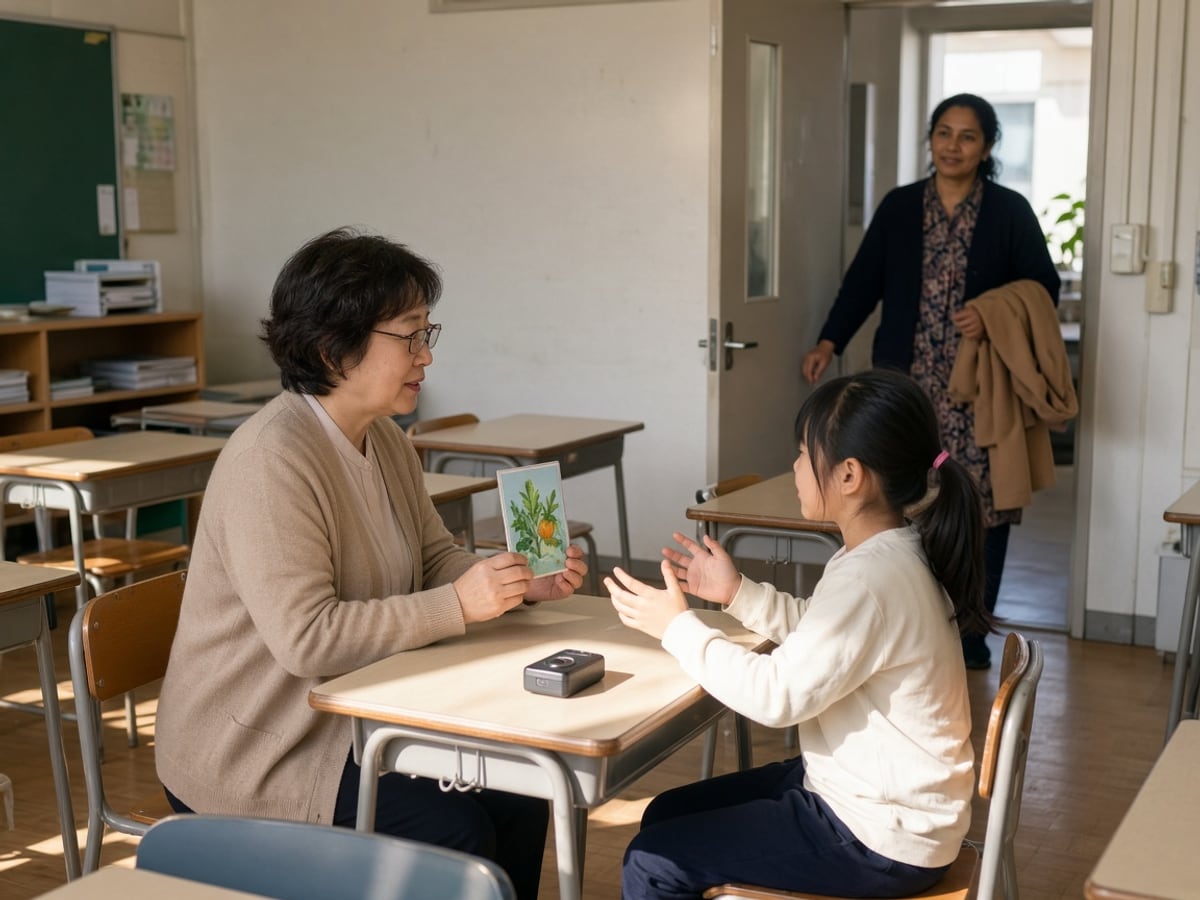
One adult, one child, a recording, and tasks chosen to fit the child (すべてのタスクを実施するのではなく、常に子どもの状況に合わせて選んで行います).
| Part | What it is | Time |
|---|---|---|
| はじめの一歩 (first step) | A warm-up chat and a 55-word picture-card vocabulary check | About 5 minutes |
| 聞く・話す (listening and speaking) | Basic tasks, a dialogue task, and a "cognitive" task using subject vocabulary | 10–15 minutes |
| 読む (reading) | One short text from a set of ten, chosen for the child, read and discussed | 10–25 minutes |
The whole thing fits inside one 45-minute lesson. The reading part is designed so the child enjoys it.
The same format exists in the child's home language. The 2025 edition has a multilingual DLA in Portuguese, Chinese, Filipino, Vietnamese, Spanish, English, Nepali and Russian, and the guidance says to use it: a child who just arrived usually cannot do the Japanese version, so the mother-tongue one, or a talk with you, is how the school learns what the child can do.
How the result is written
Not as a mark. The assessor matches what they saw against descriptive sentences in a scale called ことばの力のものさし (the "ruler of language ability"), on two axes: the child's overall language development across all their languages, judged against their age, and their acquisition of Japanese specifically, in six steps:
| 日本語の習得ステップ | The scale's one-line description |
|---|---|
| 1–2 | A very limited stock of words; starting to learn the script |
| 3 | Familiar words and expressions; single-clause sentences |
| 4 | Everyday vocabulary with limits; from single clauses to basic compound sentences |
| 5 | Wide everyday vocabulary; lower-grade-level discourse and texts |
| 6 | Vocabulary and texts needed for middle-grade subject learning |
So a result sounds like "step 4 in speaking, step 3 in reading", with notes on what help worked.
How the school uses it
The guidance suggests running it on arrival (in the home language), on transfer, around three and six months, then about once a year, and skipping the speaking part once the child chats fluently in favour of reading. It also says more than one adult should look at it:
子どもの指導や支援に関わる複数人が集まり、DLAの様子やそこから読み取れる子どもの状況を共有し、学習・指導計画について協議する場を設けることが望まれます。
That plan is what sets the hours of pull-out Japanese under the special curriculum: see Japanese-language lessons at a public school.
The DLA material also explains the gap every family notices: children are fine in everyday talk but struggle in lessons. It separates conversational fluency from the language needed for subject learning, and MEXT's handbook says the same: 学習に必要な日本語の力は簡単に身に付くものではありません。
The trap, and why not the JLPT
The trap is to hear "step 3" as a grade, or to ask for a JLPT level instead. No MEXT page read for this article mentions the JLPT, and the DLA text rejects the idea of scoring memorised knowledge. The JLPT is a paper test; DLA was built because, in MEXT's words, paper tests cannot capture a child's language. A second trap is that the result depends on the assessor's experience, which the material admits; ask who did it and whether several staff discussed it. A third: a fluent talker is assumed to need nothing, when the reading part is where the gap shows.
How to ask for the result
At the 面談 (mendan, parent-teacher meeting):
DLAは実施しましたか。結果と、個別の指導計画を見せていただけますか。
To ask for the home-language version: 母語でのDLAもお願いできますか。 Ask which parts were run, which step in speaking and reading, and what the plan says about hours. The Q&A chapter calls a parent who speaks the home language the child's closest and most important resource and tells schools to work with you. Bring previous school reports and be ready to describe what your child reads and watches at home.
What it costs
Nothing on any page: it is a MEXT tool run by school staff.
What goes wrong
- It is never run; the school "sees how the child does" instead.
- It is run once, in Japanese, on arrival, when the child cannot answer.
- The result is never shown to the family.
- Hours are set in the first month and not revisited; a yearly re-check is the design.
What to do now
- Ask the 担任 whether a DLA has been done and in which language.
- Ask to see the steps and the 個別の指導計画.
- If your child arrived recently, ask for the home-language version first.
- Put the next assessment date in your calendar and ask again then.
Your child's dates, not the general ones
Add your child and ward. The timeline does the rest.