Japanese classes outside the school day: preschools for new arrivals, and where a Tokyo family looks
学校外の日本語教室と、就学前のプレスクール・プレクラス
- Applies to
- All of Japan
- Source last checked
- , Open the Japanese source
- Official source
- 外国人児童生徒等の教育の充実に関する有識者会議報告書(令和8年6月)
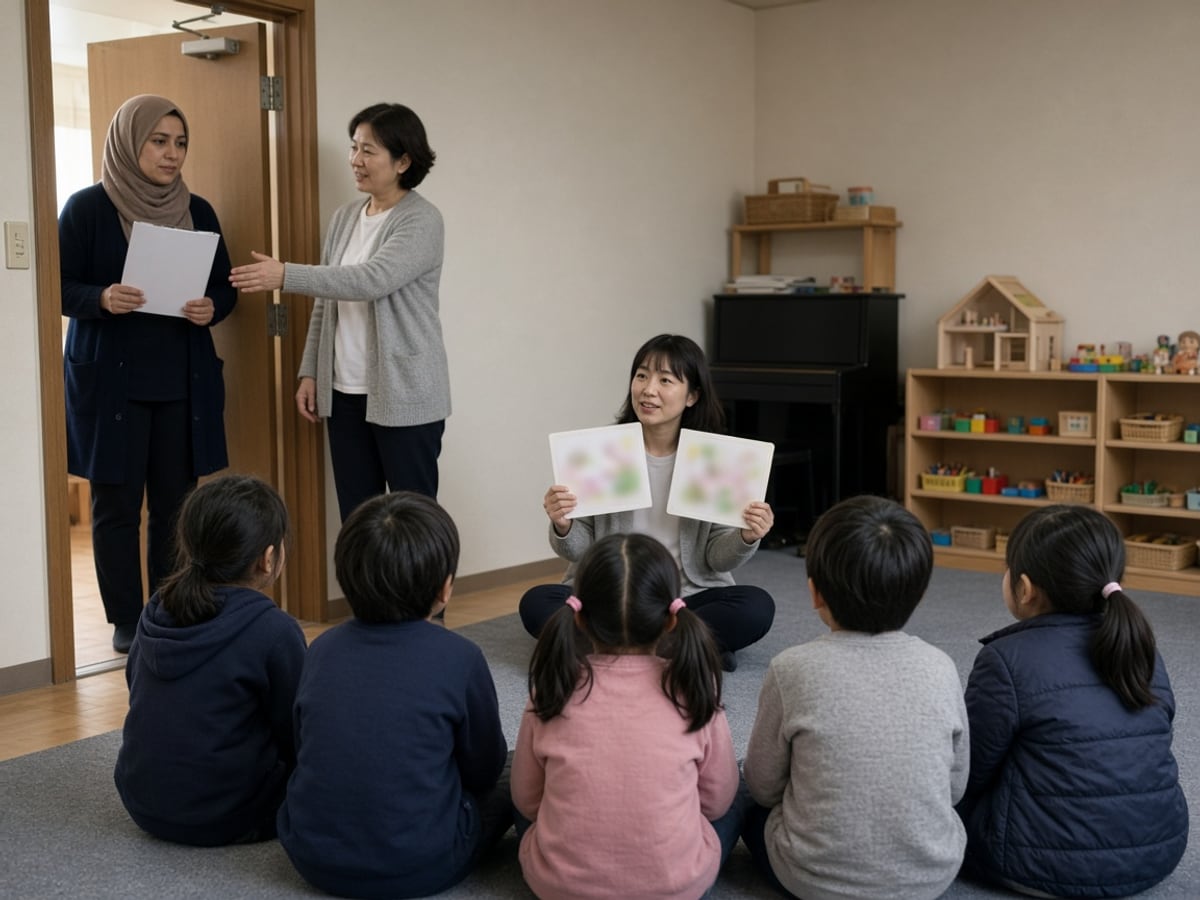
A public school can teach Japanese inside the week. That route is the special curriculum, described in Japanese-language lessons at a public school. This article is the other pile: classes before enrolment, classes in the first weeks, and classes run by a ward, a community centre or an NPO outside the timetable. MEXT's expert-meeting report of June 2026 gives the two words schools use, and it says neither word is defined in law.
The two words
The report's own footnote:
「プレスクール」「プレクラス」については、法令等における定義がなく、各地で様々な名称・形態で取り組まれているところであるが、本報告書では、主に学齢期以前の外国人幼児を対象として、入学後の円滑な学校生活につなげるための支援を行う取組を「プレスクール」、主に学齢期の外国人児童生徒を対象として、学校就学前や就学後初期段階に、円滑な学校生活につなげるための初期日本語指導等の支援を行う取組を「プレクラス」として記載する。
| Word | Who | What the report says |
|---|---|---|
| プレスクール (puresukūru) | Mainly foreign children before school age, and their parents | A head start so school begins more smoothly. Still a minority of municipalities. The operator may be the board or the mayor's department |
| プレクラス (purekurasu) | Mainly school-age children, just before enrolment or in the first weeks after it | Initial Japanese. More municipalities run one. No shared model: curriculum or not, who teaches, how long, and who may attend all differ |
The government's comprehensive measures, quoted in the report, put a strengthening of this initial support in fiscal 2027, under the provisional name プレスクール (令和9年度から、初期支援(「プレスクール(仮称)」)の抜本的な強化を図る。). Fiscal 2027 starts in April 2027. The report has no enrolment window and no fee.
What Tokyo's municipalities told the city
Tokyo's Children's Policy Coordination Office published a case collection in May 2025. Inside it is a survey of all 62 Tokyo municipalities, answered 21–30 November 2023. Every municipality replied.
| Programme | Municipalities that had one | That did not |
|---|---|---|
| Something for children not yet in school | 17 (27%) | 45 (73%) |
| Something for elementary and junior-high children | 47 (76%) | 15 (24%) |
| Anything, any age | 50 (81%) | 12 (19%) |
The same survey lists where a child is sent: a Japanese class at school (日本語学級), support inside the ordinary lesson (入り込み指導), pull-out lessons (取り出し指導), after-school Japanese, a Japanese-learning centre, or a community class run by the municipality or an NPO (地域の日本語教室). Most boards said they notice the need at enrolment or after school has started. Fewer said the resident-registration counter already points the family on.
Those percentages are November 2023, reprinted in 2025. Ask your municipality what it runs this term.
Three wards, as that collection describes them
Shinjuku, before elementary school. When a municipal kindergarten applies, the board sends a 日本語サポート指導員 (nihongo sapōto shidōin, a Japanese-support instructor). The collection says the instructor teaches Japanese in the child's home language, and that the same support can be repeated at elementary entry if needed. A booklet, 新宿区の学校生活, in eight languages, is on the ward's foreign-residents site. After school Japanese ends, the collection says learning can continue at こどもクラブ新宿, run by a ward foundation.
Taito, on Sunday. The ward's human-rights section runs a 子供日本語教室 for two hours on Sunday morning. While the child is in the class, parents sit an exchange with local volunteers. The collection says the school introduces the class. It does not print a fee or an age limit.
Sumida, from the registration counter. If a school-age child is with you, the counter points you to the board's school-affairs section. That section asks whether you want a municipal school and takes the basics: name, date of birth, address, nationality, last school, arrival date, status of residence, language. Where Japanese support looks necessary, an organisation outside the school meets the child and notes language, school history, religion, allergies and swimming. The new school's principal then decides whether the child attends that organisation while enrolled.
Supporters who come into school are still the school's job
MEXT's handbook for receiving foreign children tells schools to bring people in from outside:
近隣の大学や公的な機関など(例えば、教育委員会、公民館、国際交流協会、NPO等)からの人材の派遣・紹介を活用することも有効です。
And it keeps responsibility on the school:
あくまで主体は子供たちの教育に責任を持つ学校側、教師側にあり
Ask the homeroom teacher who comes, on which day, and who writes the plan. A volunteer does not replace the special curriculum.
Tokyo's board, in its March 2024 Japanese-teaching guideline, also draws after-school catch-up by paid volunteers, an early block at a board facility taught by a contractor, and a プレクラス at another site. It says the hours beside those forms are examples. Do not budget a week from them. How a school measures the level is the DLA, in how a school measures your child's Japanese.
Looking up a class in Tokyo
Tokyo's Bureau of Citizens and Cultural Affairs keeps a page on community
Japanese education, updated 30 July 2026. It links 東京日本語教室サイト
at https://nihongo.tokyo-tsunagari.or.jp/ and gives the desk number
03-5320-7738 (多文化共生推進担当). The May 2025 collection describes that
site as searchable by municipality, including children's classes, and as
listing online classes that can be joined from anywhere in Tokyo. Confirm
the current search on the site itself. The same collection prints subsidy
ratios the city pays to municipalities for opening classes. Those ratios
are not a fee, and not a statement that your class is free.
Kawasaki and Yokohama are outside this Tokyo survey. Ask the city board and the city's international association. The handbook's list — board, 公民館 (kōminkan, community centre), 国際交流協会, NPO — is the national checklist.
What it costs
No parent fee is printed on the MEXT report, the Tokyo survey or the three ward accounts. Ask the class about materials. A subsidy ratio on the collection is money the city pays a municipality.
What goes wrong
- Waiting until a teacher notices. The Tokyo survey says that is when most boards act, which is why the registration counter is worth using on day one.
- Treating a プレスクール as something every ward owes you. Seventeen of 62 Tokyo municipalities reported one in November 2023.
- Counting a volunteer hour as the special curriculum. The school still has to decide the curriculum; the volunteer does not.
- Reading "from fiscal 2027" as a class that is open now.
- Assuming the Shinjuku, Taito or Sumida path is your ward's path.
What to do now
- At resident registration, ask the counter for the board section that handles a school-age child's Japanese.
- Ask that section whether a プレスクール or プレクラス exists, who runs it, and whether a place is still open this month.
- In Tokyo, open the community-Japanese page and the classroom site it links, or call 03-5320-7738, and ask about a children's class.
- Ask the homeroom teacher which outside supporter comes in, and ask to see the plan. The in-school hours are a separate request.
- If you are outside Tokyo, ask your city's board and its 国際交流協会 with the same questions. Verify the answer with that office.
Your child's dates, not the general ones
Add your child and ward. The timeline does the rest.