Moving to Japan with children mid-year: the first two weeks, from city hall to school
年度の途中に子どもと来日したら:最初の2週間
- Applies to
- All of Japan
- Source last checked
- , Open the Japanese source
- Official source
- 外国人の子供の就学促進及び就学状況の把握等に関する指針(令和8年8月28日改訂、文部科学省)
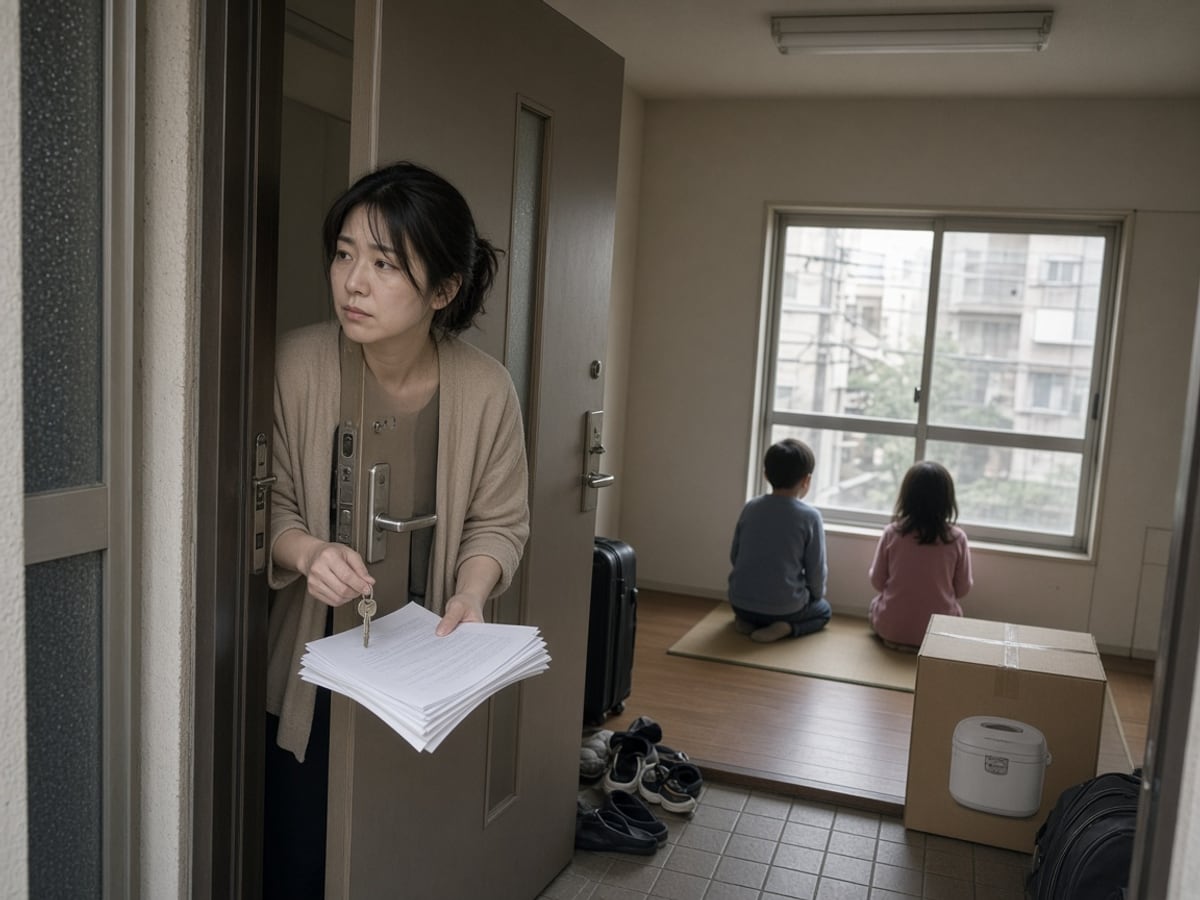
A family that lands in Japan, or that takes up a first address here, in the middle of the school year has a short list that is easy to do in the wrong order. City hall comes before the school. The payments do not start themselves. This is the landing sequence. A move from a school you already attend inside Japan is a different list: moving house inside Japan.
Days 1 to 14: the address
If you hold a residence card as a mid- to long-term resident, the Immigration Services Agency says you file the address within 14 days of the day you decide it (住居地を定めた日から14日以内). The window is the municipality. Bring the card, or the passport if the card will be posted to you later. A child under 16 does not file alone; a parent or another relative aged 16 or over who lives with the child files. The Agency's page lists no fee.
That visit is also the resident-register move-in. The Agency says that filing the register notice while showing the card counts as the immigration address notice, and that a resident record (住民票) is then created. Ask for a copy once it exists. You will show it, or the fact of it, for the allowance, the medical card and the school board.
The statuses, who does not get a card, and a child born here are in residence status and school. If the card says short-term stay (短期滞在), do this immigration conversation before you plan the school year. That status is on the Agency's list of people who do not receive a residence card.
At the same counter, ask whether anyone in the family needs to enroll in national health insurance. The pages used here do not print that deadline. The child medical card in the next step needs insurance underneath it.
The same fortnight: child allowance
Child allowance is a separate claim at the municipality, or at a civil servant's workplace. The Children and Families Agency's guide says you file a 認定請求 when a child is born or when you move in from another municipality. For a move between Japanese municipalities, the FAQ's clock is 15 days:
転出した日(転出予定日)の次の日から数えて15日以内に、必ず転入先の市区町村で申請手続きを行ってください。
Payment ordinarily starts the month after you apply. Inside those 15 days, a month-end move can still be paid for the month you moved. After that, the late months are in principle unpaid.
A child with no Japanese family register is on the guide's list of people who must still file the June status form (現況届). Most foreign children are in that group. Amounts, the third-child count, and Tokyo's separate 5,000 yen payment are in child allowance and Tokyo 018.
If the new address is in Tokyo
018 support is not the child allowance. The fiscal 2026 FAQ pays 5,000 yen a month for a child who is a Tokyo resident on the 1st of that month, with no income limit, and it includes a foreign national who meets the rules. The July 2026 payment round has passed. Apply by 1 November 2026 for the December round, or by 1 March 2027 for the April 2027 round. A move on the 2nd or later does not count that month. The call center on the FAQ is 0120-056-018, 9:00–19:00.
The medical card, then the first clinic
Tokyo, Kawasaki and Yokohama each want an application for a child medical card. The card is not issued because you enrolled at school. Ages and the yen you can still pay at the window are in child medical subsidies. Apply after the address and the insurance exist. Keep clinic receipts until the card is in your hand.
The school board, in the same two weeks
The Ministry of Education's guideline, revised 28 August 2026, says parents of a school-age foreign child (ages 6–15) are not under the school-attendance duty. It also tells the municipal board:
公立の義務教育諸学校への入学が可能であることを案内する必要がある。
Boards are told to send that guidance from the resident register, in a language the household uses.
So you go to the municipal board of education of the address you just registered, not only to the school door. Say you want a public place. Take the resident record and the residence card. Ask three things:
- Which school, and from which morning.
- Whether they are proposing a lower grade, and why. The guideline allows a temporary or formal lower grade when age-grade work is not appropriate, after an explanation. The default starting point is still age: the grade follows the child's age.
- Whether the school teaches Japanese as part of the timetable: Japanese-language lessons at a public school.
Setagaya publishes its own steps for a child of foreign nationality, including a phone number if you cannot register an address. That page is Setagaya's, not every ward's: Setagaya school entry. Ask your own board for its paper.
A child younger than school age belongs at the daycare or kindergarten counter, not the compulsory-school desk. The shape of that system is in how licensed daycare and kindergarten fit together.
Papers you cannot read yet
School handouts will arrive in Japanese. The ministry's search site for sample translations is Kasutanetto. A person on a phone, on a Friday afternoon in Tokyo or on a language-matched day in Kanagawa, is help in your language. The sample translation is not your school's deadline.
What goes wrong
- Visiting the school before the resident record exists, then being told to come back, while the 15-day allowance clock is running.
- Counting 14 days and 15 days as the same rule. The address rule is 14 days from the day you decide the address. The allowance rule, for a move between municipalities, is 15 days from the day after the planned move-out date.
- Assuming the interpreter line answers in your language on Monday.
- Paying a clinic bill in full because nobody mentioned the municipal card.
- Treating this list as the transfer list. If the child already has a Japanese public school, the current school has to issue papers first.
What to do now
City hall, the allowance, the medical card, then the board.
Your child's dates, not the general ones
Add your child and ward. The timeline does the rest.